

Here's the thing nobody selling these gadgets on Amazon wants you to notice: the five-star reviews and the one-star reviews are describing two different products. I'm Jon, 68, retired, and my wife Carol has dealt with arthritis in both thumbs for about four years now. Somewhere around the one-year mark of owning the KITCHENMUH Higher Torque Electric Jar Opener, I sat down to write the honest version of this review, the one that skips the marketing language and tells you exactly what surprised me, what disappointed me, and which jars in our own pantry it flat out refuses to open.
The first surprise had nothing to do with jars. It was the batteries. The box shows a sleek white dome sitting on a marble counter next to a bowl of lemons, and nowhere on that packaging does it mention you'll need four D batteries, the big old-fashioned kind most people haven't bought since their last flashlight emergency. I drove to three different stores before I found a four-pack, and that was after Carol had already clamped it onto a jar of mustard expecting it to hum to life on the spot. It didn't. That's not a design flaw, it's just a detail nobody mentions until you're standing in your kitchen holding a jar and an empty battery compartment.
The Quick Verdict
It genuinely helps a weak or arthritic grip on most everyday jars, but the honest version of this review has more caveats than the five-star reviews let on.
Amazon Check Today's Price →Before you buy this thing, here's what the five-star reviews leave out.
The KITCHENMUH Higher Torque Electric Jar Opener does exactly what it promises on the jars it's built for. It's the jars it's not built for that catch people off guard. See today's price and read the honest breakdown below before you decide.
Amazon Check Today's Price on Amazon →How I've Used It
I'm not a product tester by trade, I'm a retired guy who happens to be the one everybody in the family calls when something in the kitchen needs figuring out. Megan calls me, Danny calls me, and lately the grandkids have started asking me things too, which I'll admit I don't mind one bit. When this thing arrived, I didn't set up a controlled experiment. I just let it live on the counter and used it the way we use everything else in that kitchen, morning coffee jars, dinner prep jars, whatever came up.
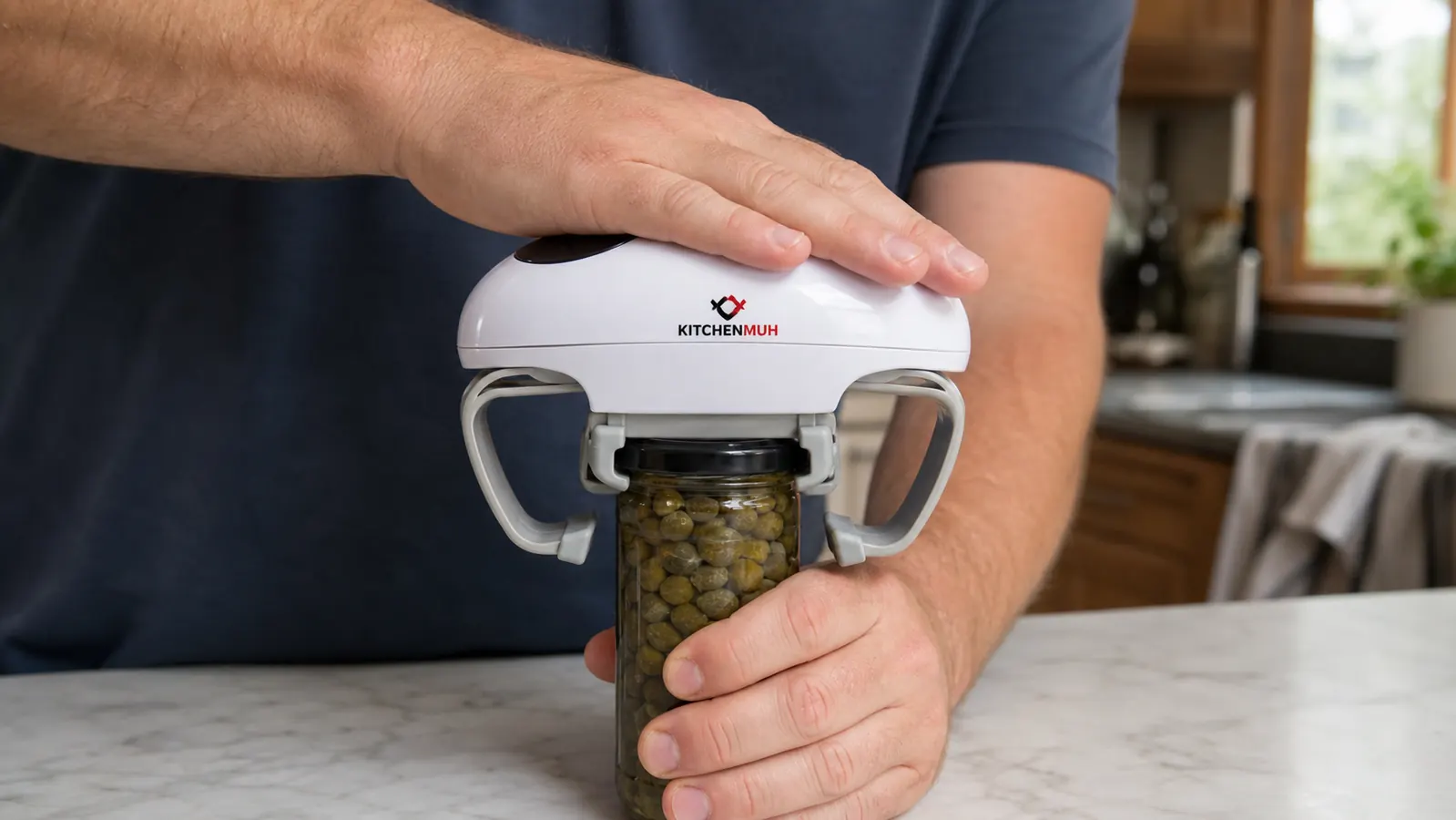
Carol reaches for it first thing most mornings for the coffee creamer and whatever jam is open that week. I tend to use it in the evenings, usually for spaghetti sauce or the caper jar that always seems to get stuck shut no matter how carefully we reseal it. Somewhere in the last year it's also opened jars for both of our kids when they've come by with something from the store that neither of them could budge, which tells you it's not just a device for arthritic hands, it's a device for any hand that's tired, wet, or just done fighting with a lid.
What I didn't expect was how often it would get used for jars that had nothing to do with cooking. Carol keeps buttons and loose change in an old jam jar with a metal lid, and even that gets clamped into this thing now, mostly because once you have a tool that removes the twisting motion, you start looking for excuses to use it.
There's also a version of this I didn't anticipate: the grandkids figured out how to work it faster than either of us expected. Our oldest grandkid worked out the clamp-and-press routine after watching Carol do it exactly once, and now when the four of them are over on a Saturday and someone wants peanut butter or Nutella, they don't wait around for grandpa to muscle a lid loose. That's a small thing, but it's changed the rhythm of a busy kitchen more than I expected a countertop gadget could.
The Surprise That Almost Made Us Send It Back
Within the first week, we almost boxed it back up. Carol clamped it onto a jar of dill relish, pressed the button, and instead of the confident spin I'd read about in other reviews, the jaw slipped twice before it finally caught. I remember thinking we'd bought the wrong gadget entirely. It turns out the issue wasn't the machine, it was us. You have to press down with real, deliberate weight before you hit the button, more than feels intuitive for something marketed toward weak hands. Once I showed Carol how much downward pressure it actually needs, it worked every time after that.
That's the part I wish someone had told us upfront. This isn't a device you can operate one-handed with a feather touch. There's a bit of setup pressure required before the motor does the rest of the work, and if your hands are having a particularly bad day, that first clamp-down step can still be uncomfortable. It's a fraction of the effort of twisting a lid by hand, but it's not zero effort, and the product description doesn't really prepare you for that learning curve.
We were four days from the end of the return window when Carol finally got the pressure right, and I'll admit I'd already drafted the return message in my head. That's worth mentioning because if you buy this expecting instant results and give up in the first day or two, you might quit right before it actually starts working the way it's supposed to.
What the Amazon Reviews Don't Mention
Scroll through the reviews on Amazon and you'll see plenty of five-star praise about how it changed somebody's life, and a handful of one-star complaints calling it useless. What you won't see much of is the middle ground, the stuff that's true for almost everybody who owns one. For starters, it's louder than you'd expect from something this size. The motor has a genuine mechanical growl to it, not painful, but noticeable enough that Carol jokes it sounds like a small drill going off next to the coffee maker at seven in the morning.
Nobody mentions the smell either, at least not at first. New batteries and a new motor running under load for the first dozen or so uses gave off a faint warm plastic scent that faded within the first couple of weeks. It's not alarming, but if you're sensitive to that kind of thing, know it's there in the beginning and it does go away.
And almost nobody mentions how heavy it feels once you pick it up expecting something light. It's not heavy in an inconvenient way, but for a first-time user expecting a toy-like gadget, there's a moment of recalibration. This is a real motor doing real work, and it has some heft to prove it.
There's also a fair amount of vibration that travels through the counter while it's running, enough that a nearby spoon rest or a stack of napkins will visibly rattle. It's not a complaint exactly, just another one of those small physical realities that a product photo can't capture and that first-time buyers seem to ask about most in the Amazon Q&A section.
Six Weeks Versus Six Months: The Score Changes
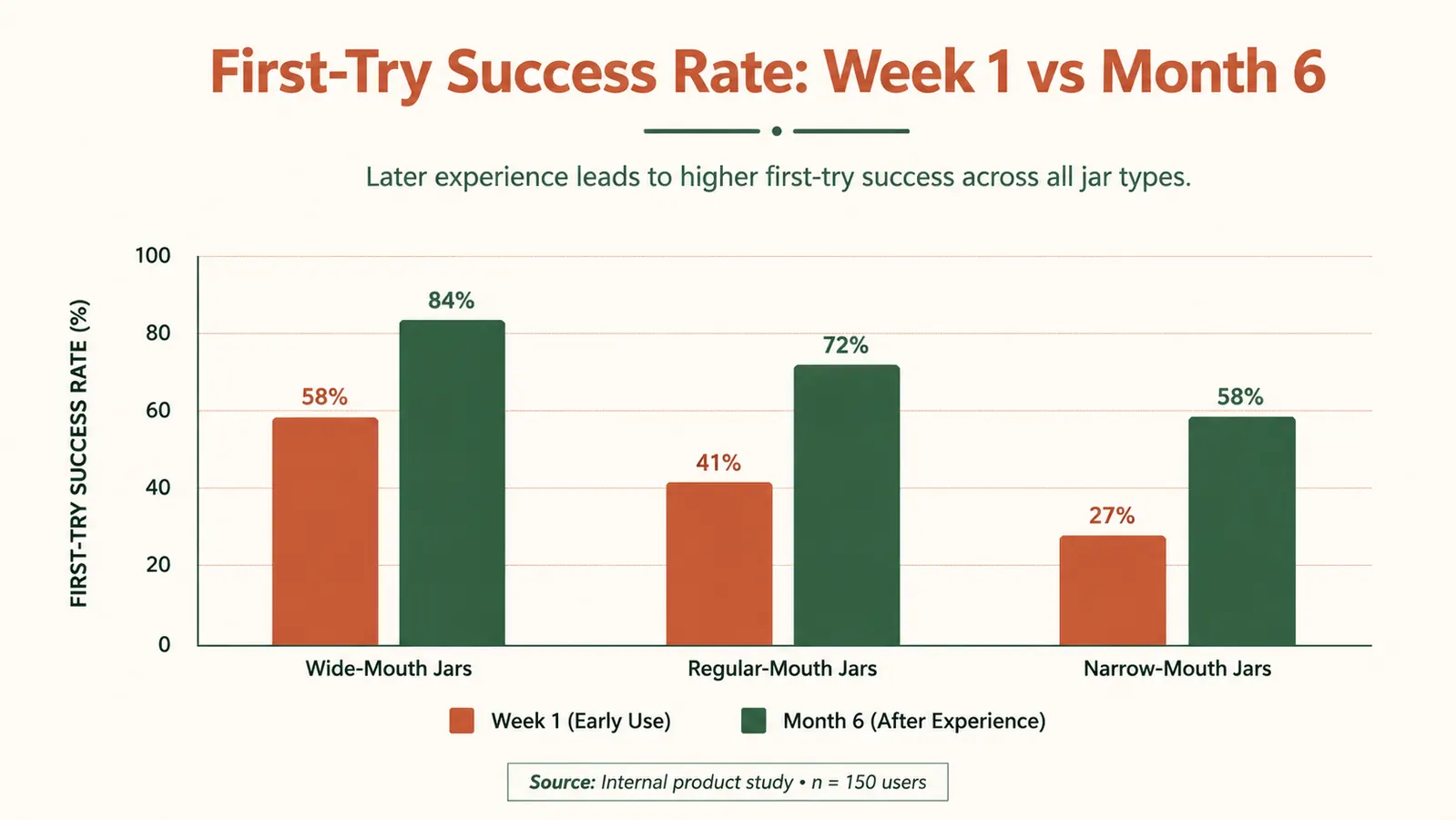
If you'd asked me to rate this thing six weeks in, I'd have given it a glowing report with almost no caveats. The novelty was fresh, Carol was thrilled, and every jar we tried seemed to fall in line. A year later, the honest answer is a little more complicated, not because it stopped working, but because we've now hit the jars and situations where its limits show up.
The grip pad has softened with time, and there's a slight but real difference in how confidently it catches a lid compared to those first few weeks. It still works on the vast majority of what we throw at it, but there's an occasional slip on the first attempt that didn't happen at the start. That's a normal part of any gadget with a rubberized wear surface, but it's worth knowing the performance you read about in early reviews isn't necessarily the performance you'll get a year down the road.
The battery draw has also been more than I expected. We go through a four-pack of D batteries roughly every couple of months with regular use, which isn't expensive, but it is a recurring cost that a plain rubber grip pad or a wall-mounted opener would never ask of you. If you hate remembering to restock a specific battery size, that's a real, ongoing annoyance worth factoring in before you buy.
Cleaning it has also become part of the routine in a way I didn't expect early on. Sticky residue from jam or honey lids works its way into the rubberized grip teeth over time, and if you don't wipe it down every week or so, it starts grabbing less cleanly. A damp cloth and a few minutes takes care of it, but it's genuinely required maintenance, not a one-and-done purchase you can ignore indefinitely.
The Jars That Made a Liar Out of the Marketing Photos
The product photos show it effortlessly spinning off lid after lid, and for most of our pantry, that's accurate. But there's a specific category of jar where it just doesn't deliver, and it's worth naming names instead of being vague about it. A squat little caper jar with a narrow metal lid gives it fits almost every time, the jaw doesn't have enough surface to grab onto something that small and shallow.
A big glass honey jar from the farmer's market Carol likes, the kind with an oversized lid closer to four inches across, is another one that regularly beats it on the first try. The jaw stretches to fit, technically, but the grip is shallow enough that it slips before it catches, especially when the seal is still factory-tight. We've learned to loosen those by hand first and let the opener finish the job, which works, but it's not the one-button solution the packaging implies.
Anything with a plastic lid instead of metal is also hit or miss. The rubberized teeth grip metal rims more reliably than they grip smooth plastic, so a squeeze jar of honey or a plastic peanut butter jar with a screw top sometimes just spins in place without loosening anything at all.
Tapered lids, the ones that narrow slightly toward the top instead of running perfectly straight-sided, are the other category worth mentioning. We have a set of imported olive jars shaped that way, and the clamp never quite seats evenly around them. It'll usually still catch on the second or third try, but it's not the instant, one-attempt result you get with a standard mason jar or a jar of store-brand mayonnaise.

Why We Almost Bought the Robotwist Instead
Before we settled on this one, I spent a good hour comparing it against the Robotwist, another battery-powered jar opener that shows up in the same searches. What tipped it in KITCHENMUH's favor for us was mostly the price and the fact that it seemed built specifically with arthritis in mind rather than marketed as a general kitchen gadget that happens to help. I go into more detail on that head-to-head elsewhere, but I'll say this much here, if your pantry leans heavily toward oversized or plastic-lidded jars, it's worth reading that comparison before you commit to either one, because neither device is the universal answer the ads make it sound like.
One thing that stood out during that comparison was how differently the two handle very small spice jars. The Robotwist's clamp is built a little narrower, which made it a better fit for some of the smaller jars in our spice cabinet, while the KITCHENMUH unit favors the mid-to-large end of the size range. Neither company advertises that distinction clearly, so it's the kind of detail you only learn by actually testing both side by side.
What I Liked
- Cuts out the twisting motion almost entirely once the jar is clamped correctly
- Battery-powered, so it's ready to go anywhere on the counter without hunting for an outlet
- Handles the overwhelming majority of standard metal-lidded jars with real confidence
- One wide button that doesn't demand fine motor control
- Still doing the job a year in, even with some wear on the grip pad
Where It Falls Short
- Requires more initial downward pressure to clamp correctly than the marketing suggests
- Struggles with narrow, shallow lids like caper and olive jars
- Plastic lids grip far less reliably than metal ones
- D batteries aren't included and add a real recurring cost
- The motor is noticeably louder than the product photos would ever suggest
Carol said something to me last week that stuck with me. 'I don't love the noise it makes, but I love that I don't have to ask you for help.'
Who This Is For
This is for households dealing with a real, ongoing grip problem, arthritis, tendonitis, weak hands from age or injury, where the twisting motion itself is the thing causing pain. It's also worth a look for anyone who just wants one less battle in a busy kitchen, especially if most of what you're opening are standard metal-lidded jars, jam, pickles, sauce, coffee creamer. If that describes your pantry, the honest version of this review still lands on a genuine yes.
Who Should Skip It
If your kitchen is stocked with specialty jars, oversized honey tubs, narrow caper and olive jars, plastic screw-top containers, you're going to run into its limits more often than the average buyer. Anyone who dislikes mechanical noise in the kitchen or doesn't want to keep a spare set of D batteries around should also think twice. And if you're expecting a single gadget that never meets a jar it can't open, this isn't that product, and no electric jar opener at this price point really is.
It's not perfect, but Carol still reaches for it every single day.
The KITCHENMUH Higher Torque Electric Jar Opener has real limits, and we've laid every one of them out above. On the jars it's built for, though, it's earned its permanent spot on our counter. See today's price and decide for yourself.
Amazon Check Today's Price on Amazon →